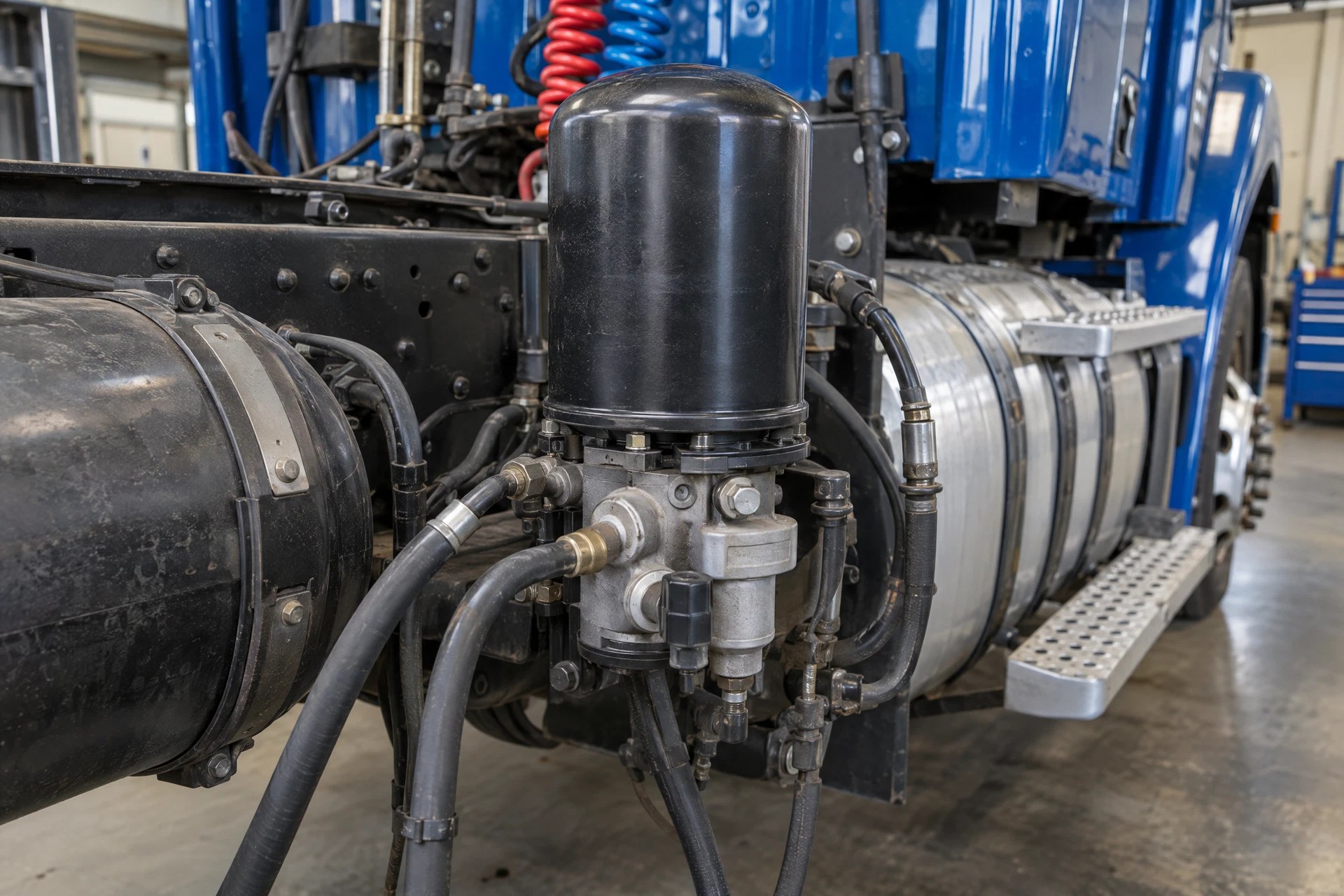
SUPPLY: Slow/no build, rapid pressure loss and repeated dryer cycling begin upstream with leakage and supply/control testing.
APPLICATION: A leak that appears only when the pedal is applied points toward circuits activated during service braking.
RELEASE: Parking brake that will not release requires sufficient air, a release command, delivery to spring chambers and free foundation brakes.
BRAKING FORCE: Weak brakes, pulling and long stopping distance require side-to-side and tractor/trailer comparison of delivery, chamber movement and foundation brake condition.
STROKE / ADJUSTMENT: Excessive stroke is a symptom to diagnose, not something to hide with repeated manual adjustment.
HOT WHEEL: Separate pneumatic/mechanical brake drag from wheel-end or tire heat.
ABS: Save the complete electronic fault and follow power, wiring, sensor/signal and mechanical wheel-end evidence separately from pneumatic complaints.
⚠️ Air brakes are safety-critical. Properly secure/support the vehicle, never disassemble spring-brake chambers improperly, follow current manufacturer procedures and applicable regulations, and fully verify brake operation before returning the vehicle to service.
More symptoms in this system
Use these focused checks alongside the system explanation above. Confirm the exact vehicle configuration and current manufacturer procedures before testing or repair.
🧰 AIR COMPRESSOR NOT BUILDING PRESSURE?
Quick answer
Do not replace the compressor until you prove it cannot supply air. A major system leak, governor/unloader control problem, restricted compressor intake, discharge-line problem or air-dryer/supply-path fault can all produce little or no tank-pressure increase. Follow the compressor and chassis manufacturer's test procedure to separate compressor output from downstream loss.
Diagnostic order
Check for a massive audible air leak before testing the compressor.
Confirm the compressor is mechanically driven as designed.
Inspect compressor intake supply for restriction/damage.
Verify governor/unloader control state using manufacturer procedures.
Inspect discharge plumbing for damage, leakage, blockage or severe restriction.
Inspect dryer/supply path and related check-valve/control components according to the system schematic.
Perform the OEM compressor output/build test before condemning the compressor.
Pattern clues
Pressure never rises from near zero: look for major loss, supply-path blockage/control issue or lack of compressor output.
Pressure rises but extremely slowly: use the dedicated slow-build path and compare leakage with compressor performance.
Air continuously exhausts at dryer: diagnose purge/control and compressor loaded/unloaded state.
Problem started after compressor/dryer/governor repair: verify line routing and component installation against the schematic.
🧠 Parts-cannon rule: no tank pressure does not automatically equal a failed compressor. Prove compressor output separately from downstream loss or restriction.
⚠️ Never disconnect a pressurized air line. Secure the vehicle and exhaust the affected circuit before service.
Build the system to normal pressure, secure the vehicle and determine when the pressure loss occurs: brakes released, service brake applied, parking brakes released, trailer connected or disconnected, or suspension/accessories active. That condition tells you which branch to isolate. A fast pressure drop is not automatically a bad compressor—the compressor may simply be trying to replace air the system is losing.
Isolation order
Record primary and secondary gauge behavior.
Compare engine running versus engine off using approved leak-test procedures.
Listen and use approved leak-detection solution at fittings, valves, chambers and lines.
Compare service brake released versus applied.
Compare tractor-only versus trailer connected.
Check suspension and accessory circuits if loss changes with those systems.
Trace the leaking branch before replacing the component where the air is heard.
Pattern clues
Drops only with service brake applied: focus on service delivery circuits, chambers, hoses and related valves.
Changes when trailer is disconnected: isolate tractor supply/control from trailer-side leakage.
Air heard at a valve exhaust: the valve may be exhausting air supplied backward from another failed component. Trace the source.
Truck also builds air slowly: diagnose leakage and supply/compressor performance together.
🧠 Parts-cannon rule: replace the failed source, not automatically the valve where you hear the air escaping.
⚠️ Air brakes are safety-critical and contain stored energy. Chock/support the vehicle and follow approved brake-system service procedures.
Excessive pushrod travel is evidence of a brake-system problem. Do not make repeated manual slack-adjuster corrections and call it fixed.
1️⃣ IDENTIFY COMPONENT: Determine chamber type/size, brake type and the applicable stroke limit from current specifications.
2️⃣ MEASURE CORRECTLY: Follow the prescribed pressure/application and measurement procedure. Incorrect test pressure or reference points can create bad conclusions.
3️⃣ COMPARE POSITIONS: Compare axle mates and look for one brake that behaves differently.
4️⃣ FOUNDATION BRAKE: Inspect friction wear, drum/rotor, cam or caliper mechanism, bushings/hardware and mechanical movement as applicable.
5️⃣ SLACK ADJUSTER / LINKAGE: Inspect installation, geometry and automatic adjuster operation using manufacturer procedures. Repeated loss of adjustment means the underlying fault remains.
6️⃣ VERIFY: Re-measure stroke after repair and complete the required brake inspection.
IDENTIFY CHAMBER → CORRECT TEST → MEASURE → FOUNDATION BRAKE → ADJUSTER/LINKAGE → REPAIR → RE-MEASURE.
⚠️ Brake stroke limits are component-specific and regulated. Use the current chamber/brake manufacturer specifications and applicable inspection rules.
🦶 AIR LEAK WHEN BRAKE IS APPLIED
If the leak appears only during service-brake application, focus on circuits that become pressurized or change state during that application.
1️⃣ SECURE VEHICLE: Chock/support correctly before stationary brake testing.
2️⃣ CONFIRM CONDITION: Released, light application, full application, held application? Record when leakage begins.
3️⃣ LOCALIZE SOUND / FLOW: Treadle/foot valve area, service lines, relay valves, chambers, fittings, tractor protection/trailer circuits can all require inspection depending on system design.
4️⃣ TRACTOR VS TRAILER: If connected to a trailer, isolate the complaint using approved procedures. Do not assume a tractor valve when the leak is downstream.
5️⃣ MEASURE: Use the applicable air-loss and component test specifications rather than deciding from sound alone.
RELEASED OR APPLIED? → LOCALIZE → TRACTOR/TRAILER → COMPONENT TEST → PROVE → REPAIR → AIR-LOSS VERIFICATION.
⚠️ Never crawl beneath an unsecured air-suspended vehicle. Air-brake repairs require complete functional verification before road use.
↔️ PULLS WHEN BRAKING
A brake pull is a left-to-right braking-force imbalance until proven otherwise, but tires, steering and suspension can imitate it.
1️⃣ VERIFY: Does it pull only during brake application? Record speed, load, road crown and whether tractor or trailer feels responsible.
2️⃣ TEMPERATURE / EVIDENCE: Compare wheel/brake temperatures after a controlled event where safe. A hot or cold position can help identify over- or under-performing brakes.
3️⃣ AIR DELIVERY: Inspect/test service air delivery, hoses, valves and chambers using the correct procedure. Compare sides rather than judging one component alone.
4️⃣ FOUNDATION BRAKES: Inspect adjustment, stroke, friction condition, contamination, drum/rotor condition, hardware and mechanical movement per brake type.
5️⃣ NON-BRAKE CAUSES: Tire pressure/condition, alignment, steering looseness and suspension movement can change direction under braking.
6️⃣ VERIFY: Confirm balanced brake operation and straight controlled stopping before release.
ONLY UNDER BRAKING? → COMPARE SIDES → AIR DELIVERY → FOUNDATION BRAKE → TIRE/STEERING/SUSPENSION → PROVE → VERIFY.
⚠️ Brake pull is safety-critical. Secure/support the vehicle properly and follow current brake manufacturer procedures and inspection limits.
🛑 BRAKES FEEL WEAK / STOPPING DISTANCE LONG
Treat reduced braking performance as an out-of-service safety concern until the complete brake system is inspected and proven.
1️⃣ DEFINE: Tractor, trailer or combination? Always weak, after repeated stops, after service, or only loaded?
2️⃣ AIR SYSTEM: Verify supply pressure, application behavior and abnormal leakage using the correct vehicle procedure.
3️⃣ BRAKE STROKE / ADJUSTMENT: Inspect chamber stroke and adjustment to applicable limits. Automatic slack adjusters should not be repeatedly hand-adjusted as a substitute for finding the fault.
5️⃣ DELIVERY / BALANCE: Verify valves, chambers and tractor/trailer delivery where braking is uneven or delayed.
6️⃣ HEAT / FADE: If performance changes after repeated braking, investigate overheating, adjustment and friction condition rather than continuing to operate.
DEFINE → AIR SUPPLY/APPLICATION → STROKE/ADJUSTMENT → FRICTION → DELIVERY/BALANCE → PROVE → FULL BRAKE VERIFICATION.
⚠️ A vehicle with inadequate braking performance must not be returned to service until the cause is corrected and the braking system passes required inspection/testing.
🔒 PARKING BRAKE WON’T RELEASE
Spring brakes require adequate release pressure and a working control/delivery path. Separate no release air from mechanical brake binding.
1️⃣ SYSTEM PRESSURE: Verify the vehicle has sufficient air pressure for normal release according to its specifications.
2️⃣ CONTROL: Verify parking-brake control operation and whether release air is being commanded/delivered.
3️⃣ DELIVERY PATH: Inspect/test applicable valves, hoses, fittings and chamber supply. A restriction or leak can prevent full release.
4️⃣ SPRING BRAKE CHAMBER: Follow chamber manufacturer procedures. Never disassemble a spring-brake chamber containing a powerful compressed spring.
5️⃣ FOUNDATION BRAKE: If chamber movement/release is correct but wheel remains held, inspect mechanical brake components, adjustment and seizure/binding.
AIR PRESSURE → RELEASE COMMAND → DELIVERY → CHAMBER MOVEMENT → FOUNDATION BRAKE → PROVE → VERIFY.
⚠️ Spring-brake chambers can contain lethal stored energy. Never disassemble them unless specifically designed/serviceable and you are following the manufacturer procedure.